From the category archives:

Writing Gooder Today

Ad Writing: Sweeter Words & Sharper Verbs

12.01.2009 Message Development Development

Yesterday, I shared a script I wrote that, basically, said:
Les Bourgeois is a great place to spend time with friends in a fantastic atmosphere! Experience the Les Bourgeois experience at a place that’s second-to-none! For all your get-together needs, try us.
Only … I didn’t write that.
But I’ve read and heard the equivalent about a bazillion [...]

0 comments Read the full article →

No Greater Gift: Understanding Time vs. Money

11.30.2009 Civics' Lessons

Whooooooooooooooooooooooooosh.
We met in 1993. In 2000, I stood up at his wedding.
Before we could sit down again, life happened.
Sound familiar?

Nearly 10 years, 250 miles and 3.3 kids later, he’s here visiting.
When you get a bit older, time tugs a little harder in the war against money.
They’re two sides of the same coin, you know?
Time and [...]

0 comments Read the full article →

Ad Writing: iDramatizing the Benefit

11.13.2009 Message Development Development

Yesterday, I showed you how eBay demonstrated the visceral difference between showing and telling in advertising. Today, I’d like you to take a look at my favorite example from the last 10 years. While Archos was intellectually bullet-pointing the features of their new-fangly mp3 players, another company took a decidedly different approach to marketing theirs. [...]

0 comments Read the full article →

Ad Writing: Showing v. Telling

11.12.2009 Message Development Development

“Don’t tell her your courteous, son. Open her door.”
In other words, don’t tell her, son. Show her.
Welcome to the the fertile fields of ad writing. I was cleaning up a presentation on ad writing that once provided a dozen meaty, actionable tips for making your ads more memorable. It’s since grown to an eighteen [...]

0 comments Read the full article →

Car Insurance

08.12.2006 Writing Gooder Today

When it matters, have someone else edit your work. If you’re lucky, it’ll be someone who views the world through a different lens than you.
If you’re really lucky, it’ll be Roy H. Williams, as was recently the case when he took a draft I wrote for the Founder of New School Selling, Steve Clark, and he edited the poop out of it.
Steve hired me to craft an invitation to successful sellers interested in becoming sales trainers sans sleaze.
I wrote. And wrote. And wrote. Even edited the heck out of it. Just not the poop. It took another to look at it objectively.
Here’s the original (in Word format)
Here’s the poop-free version.
Once I read the edited version, it quickly became clear what I should have done. Isn’t that always the way?
My partners (and authors of the Wall Street Journal #1 Business Book in America) Jeffrey and Bryan Eisenberg do their best to remind writers that people tend to view the world through one of four such lenses.
My writing wheelhouse is speaking directly to amiables and, to a degree, expressives. Gooder writers don’t let the other personality pitches go by them.
Sometimes it takes a fresh pair of eyes to make you see clearly what to leave out.
(Along the same lines, did you read about the other creepy, wordy guy who reeeeeeeeeeally needs to learn the power of knowing what to leave out?)

0 comments Read the full article →

Start Writing Gooder Today - Tool #9

07.23.2006 Writing Gooder Today

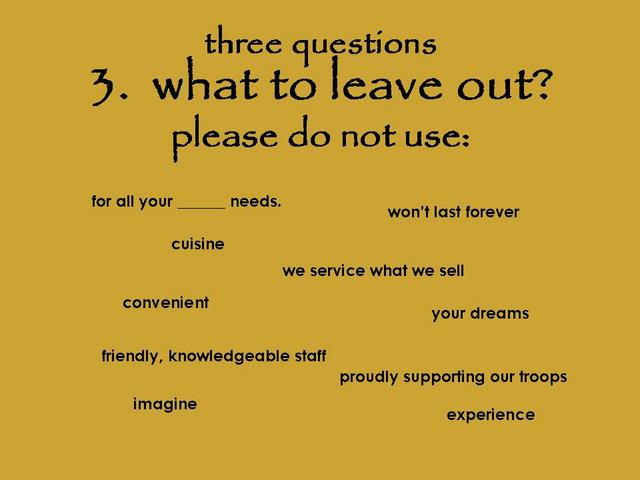
Tool #9 – Know What to Leave Out.

Yes, superficially I’m talking about cliches that water-down and weaken effective messages.  So, let’s get a few out of the way:

Leaveoutslide30

Don’t use any of them again … ever … please … unless you’re doing it to prove a point.  Insipid cliches will run us all out of this business and into a new
career because - and it won’t be long - a new generation is finally
starting to step up and say, ’sorry … we’ve been to the carnival one
too many times, thank you.’

But knowing what to leave out is simply far more complex than ditching overused words and phrases in a boring, predictable order. 

Knowing what to leave out takes the best of what you’ve learned from knowing where to end and where to begin and forces you to examine what really matters to the customer.

Write.  Then as you re-read, if it sounds like an ad, get it out of your ad.  Think of your client as an onion.  Peel away all the layers of crap till you get to one nugget of truth that resonates with you.

Because you’re pretty incredible, and if it resonates with you, I promise you there are thousands of others who will think it’s pretty neat, too.

Dig for the diamond.  Peel back the layers of the onion.  Search for the truth.

It will set you free.

Shameless Self-Promotional Note:  The above slide is taken from my presentation:  Write Gooder.  There are several more slides.  They have interesting stuff and all are presented on that soothing shade of brown.  We’ll sing.  We’ll laugh.  We’ll cry.  People seem to like it and have remarked that it’s stuff they’ve been able to not just think about but return to work and actually use.  If you’d like to see it, I have a limited number of dates open in 2006.  Let me know.

0 comments Read the full article →

Tool #8 - Part II

07.21.2006 Writing Gooder Today

Tool #8 – Know Where
to Begin (continued)

So, let’s assume you’ve spoken with the person for whom you’re writing.  You’re confidently fixed on their north star - you know where they want to end.  You feel as though you’ve gotten through the crap and detritous and down to the core of who they are, as opposed to who you wish they would be.  You’ve got the goods, and you’re ready to begin.

Now what?

BridgekeeperAnswer me these questions three, ‘ere the other side you’ll see:

1.  What’s the common demoninator of all the people we’re trying to attract?

2.  What attracted them to that common demoninator?

3.  What is their great frustration?  What is their unscratched itch?

We’re not talking about some series of features and benefits.  We’re not talking about being clever or creative.  We’re talking about your message becoming the bridge over which the people we’re trying to attract may cross to have their itch scratched by your client.

We’re not talking about emotions, really, either.

We’re talking about values.

Your client’s business raises the flag under which their tribe may gather.

What’s the anthem of their tribe?

Now, go write.

0 comments Read the full article →

Start Writing Gooder Today - Tool #8

07.15.2006 Writing Gooder Today

Tool #8 – Know Where
to Begin.

We’ve talked about this in previous lessons, but we’ll repeat it here for the sake of frequency …

One of the questions I’m most often asked is where I get all my ideas.

Let me say they’re rooted in a clear establishment of the client’s goals.  Once we know in what direction we’re heading all we need to do is take a proper first step.

What I don’t do is try and start by being clever or funny or set out trying to win an award.  Don’t waste your client’s time by trying to do that either.  Start by pulling the truth out of your client.

A WARNING:  If you ask stupid, shallow questions, please don’t be shocked or frustrated by stupid, shallow answers that lead to stupid, shallow (and sometimes clever, funny, and award-winning) advertising.  Thank you.

When speaking with your client, if you let him get away with, "well, ya know, we really care about our customers, and we’ve got such a friendly, knowledgeable staff … yep, I’d have to say it’s definitely our people that make the difference."

Once, a radio sales rep in southern Illinois actually told me her client ‘really cared about their customers,’ and I said to her that people always say that.  She replied, ‘Oh, but these guys reaaally do.’

Oh.  Well.  Okay, then.

Never put anything into your client’s campaigns that they can’t back up with specific stories and examples.  Ask them to give you an example.  Ask them to tell you a story.  Ask them to prove what they say.  Their would-be consumers demand it.

Funny thing is - consumers want it proven to them and are far more interested in hearing stories and examples that ring of truth than the same tire ‘we care about our customers’ cliches they’ve been beaten with over the head for years.

So, today we’ve briefly talked about where not to begin.  Tomorrow, we’ll show a little glimpse into where you may begin.

0 comments Read the full article →

Start Writing Gooder Today - Tool #7

07.13.2006 Writing Gooder Today

Where We’ve Been…..

 We discussed the three
values inherent in every gooder writer: curiosity, knowledge, and courage, and their symbiotic
relationship.
An
overwhelming curiosity drives you to learn more about your client and her
business. That knowledge – combined with
a better understanding of advertising – grows your courage to do the right
thing without compromise. That courage –
combined with the results you see doing it the right way – leads to more
overwhelming curiosity about other businesses and other ways to do it right.

 Seek and Ye Shall
Find

 Over
the years, I’ve spent countless hours sitting in front of a word processor,
legal pad, or bar napkin staring blankly into the abyss waiting. For what? You tell me.

 Inspiration?

Divine Providence?

Another Drink?

Let
me be clear: The hardest way to write
copy is to stare blankly at the screen or piece of paper in front of you. You have to start somewhere. Bolstered with curiosity, knowledge, and
courage, I suggest you always start by asking yourself three questions.

Tool #7 - Do You Know Where to End?

Cheshire

Wasn’t
it the Cheshire Cat who said, “If you don’t know where you’re going, any road
will get you there?”

 Why,
then, is it so hard to start writing when you’re staring at the blank
screen? Because you do know, in generalities, where you have to go.

 And
that’s the problem. We’re not in the
business of generalities. And that’s why
the first question you need answered is “Where to end?”

 You
don’t write gooder ads by trying to make the client happy. You cannot control her mood. You need to know what it is, specifically,
the business owner wants to have happen.

 “Mr.
Business Owner, do you want me to help you promote a specific event?”

 “Ms.
Business Owner, do you want me to make you a household name?”

 Because
I’m going to use different strategies to accomplish the former than I am for
the latter. And I need to know up front
what you want to have happen. It ain’t
my business. It’s yours. I can only help to accelerate what’s already
going to happen anyway, so I need a clear definition from you of what you want
that endgame to be, please.

0 comments Read the full article →

Start Writing Gooder Today - Tool #6

07.11.2006 Writing Gooder Today

Wpea2

Tool #6 - Courage


Do you
have the guts to do what’s best for your client? We’ve talked about why and how. Let’s briefly discuss who by me asking you a question: 


Who do you work
for?


Do you work for
your station? By that I mean, is your
utmost loyalty to your quarterly goal and your number of closes each week?


Or do you work for
your clients? Are you willing to not
recommend a particular package of the week to your clients because you happen
to think it’s crap? Are you willing to
stand up for the right message the right number of times when your client
thinks she knows best? Are you willing
to recommend another medium? An
additional station owned by your ‘competition?’ Are you willing to tell them to hold off on advertising for their
restaurant until they get past the rat problem?


Are you willing to
walk away from a sale because you know in your heart and mind you can’t
possibly achieve their expectations?


Careful research
has shown me that if you work for the client the rest takes care of itself.


Can’t have one without the … other …


Here’s the dandy
thing about these three values: curiosity, knowledge, and courage - properly
developed, they prop each other up when you’re having a rough day.


An overwhelming
curiosity drives you to learn more about your client and her business. That knowledge – combined with a better
understanding of advertising – grows your courage to do the right thing without
compromise. That courage – combined with
the results you see doing it the right way – leads to more overwhelming
curiosity about other businesses and other ways to do it right.


And the circle
goes ‘round and ‘round.


Let’s all hug.

0 comments Read the full article →