From the monthly archives:

April 2005

Something to the Dangled Ole' Internet Thing

April 27, 2005

Hmm … beginning to think there’s something to the fact that words matter on your website … guess I’m not alone.  I received the following email today from my partner, Sonja Howle, who teaches a course at The Academy on how to select the proper artwork to reinforce your company’s essence.

From: Sonja Howle 
Sent: Wednesday, April 27, 2005
10:44 AM
To: WOA Partners
Subject: New Yahoo VP says it’s
all about storytelling
"The thing I’m most excited
about is the next phases of Internet development, which I believe will be about
storytelling. You need good storytellers … I don’t think the Internet as a
medium has come anywhere close to realizing its potential as a storytelling
medium."

-
Scott
Moore, ex-general manager of MSN Programming who on May 2, becomes vice
president of content operations for Yahoo!’s fledgling Santa Monica,
Calif.-based Media Group.
 
Read the full article →

A Virtual Half-Step

April 27, 2005

On Monday, Roy H. Williams joined me on the Eagle 93.9 to discuss marketing and advertising for small and medium-sized owner operated businesses.  One of our topics was how best such a business should use the internet to their advantage.  An excerpt:

TM:  It’s one thing for eBay, Amazon.com, google, to make money on the internet.  How can a small or medium-sized owner operated business in central Missouri use the internet to their best advantage?

RHW:  Very simple, Tim, and I’m glad you asked … the website today is essential to every business, but you don’t need to sell product online.  Your website should be a half-step between your advertising and your store.  A half-step.  Think of it as an instantly deliverable, instantly updatable, full color brochure that is available 24/7 in the privacy and comfort and seclusion of your customer’s home … or business … or private-space.

This particular conversation went deeper.  I will post more tomorrow.  Suffice to say, the words and choices you make in constructing and maintaining your website help your customers and potential customers see you real.

The question you must ask yourself, then, is do you know who you are?

Read the full article →

Counter-Branding

April 25, 2005

Thanks to Roy H. Williams for joining me on the Eagle 93.9 this morning.  I will post excerpts of our interview here this week.

This week’s memo:

Monday Morning Memo for April 25, 2005

Counter-Branding

When
your business category is dominated by a single brand and all the other
brands put together don’t equal them, it’s time to create a
counter-brand.

Counter-branding – business judo – is rare and dangerous. But when you’re overwhelmingly dominated, what have you got to lose?

Prior to the creation of their "Uncola" counter-brand in 1967, 7-Up had
survived for 38 years as a lemon-lime soft drink with the slogan, "You
Like It. It Likes You."

Yippee Skippy call the press, a soft drink likes me.

As in Judo, the secret of counter-branding is to use the weight and
momentum of your opponent to your own advantage. In other words, hook
your trailer to their truck and let them pull you along in their wake.

The steps in counter-branding are these:

1. List the attributes of the master brand. In the case of 7-Up,
the master brand was "Cola: sweet, rich, brown." Everything else was
either a fruit flavor or root beer and all of those put together were
relatively insignificant. "Cola" overwhelming dominated the mental
category "soft drinks."
2. Create a brand with precisely the opposite attributes. To accomplish this, 7-Up lost their lemon-lime description and became "The Uncola: tart, crisp, clear."
3. Without using the brand name of your competitor, refer to yourself as the direct opposite of the master brand.
7-Up didn’t become UnCoke or UnPepsi as that would have been illegal, a
violation of the Lanham Act. But when you’re up against an overwhelming
competitor, you don’t need to name them. Everyone knows who they are.

Let’s look at a current example: Starbucks. Notice how I didn’t have to
name the category? All I had to say was "Starbucks" and you knew we
were talking about coffee. That’s category dominance.

In the February 2005 issue of QSR
magazine, Marilyn Odesser-Torpey writes about Coffee Wars, opening with
the question, "Starbucks will certainly remain top dog among coffee
purveyors, but who is next in line?" A little later we read, "Many of
the competitors in the coffee segment are Starbucks look-alikes; if you
take the store’s signage down, it would be hard to tell the difference."

Traditional wisdom tells us to (1.) study the leader, (2.) figure out
what they’re doing right, (3.) try to beat them at their own game. This
strategy can actually work when the leader hasn’t yet progressed beyond
the formative stages, but when overwhelming dominance has been
achieved, as is currently the case with Starbucks, such mimicry is the
recipe for disaster. Are all competitive coffee houses forever doomed
to occupy the sad "me-too" position in the shadow of mighty Starbucks? Yes, until one of them launches a counter-brand.

To determine what a Starbucks counter-brand would look like, we must first break Starbucks down into its basic brand elements:

1. Atmosphere: quiet and serene, a retreat, a vacation, like visiting the library. Bring your laptop and stay awhile. They’ve got wi-fi.
2. Color Scheme: muted, romantic colors. Every tone has black added.
3. Auditory Signature: music of the rainforest, soft and melodious
4. Lighting: subdued and shadowy, perfect for candles or a fireplace.
5. Pace: slow and relaxed. This is going to take awhile, but that’s part of why you’re here.
6. Names: distinctly foreign and sophisticated. Sizes include
‘Grande’ and ‘Venti.’ (No matter how you pronounce these, the ‘barista’
will correct you. It’s part of the whole Starbucks
wine-bar-without-the-alcohol experience.)

Counter-brands succeed by becoming the Yin to the master brand’s Yang,
the North to their South, the equal-but-opposite ‘other’ that neatly
occupies the empty spot that had previously been in the customer’s mind.

Here’s what a Starbuck’s counter-brand would look like:
1. Atmosphere: energetic and enthusiastic. Running shoes instead of bedroom slippers. Leave the car running because we won’t be here long.
2. Color Scheme: bright, primary colors such as are found in athletic uniforms, against a background of white or off-white.
3. Auditory Signature: anything with a driving beat, faster than a resting heart-rate. Dance music.
4. Lighting: dazzling, like in a sports arena.
5. Pace: driven by the music, on the move. Caffeine!!!
6. Names: straightforward and plain. Descriptive, rather than pretentious.

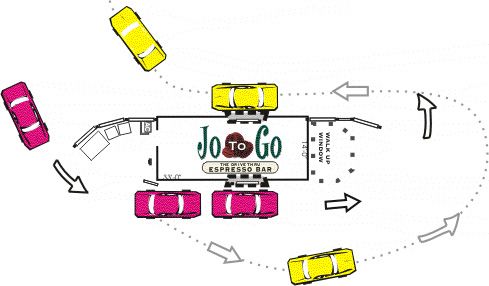
HOW IT MIGHT SOUND ON THE RADIO: Most people think to get a fast cup of coffee you have to settle for fast-food coffee …or worse…convenience store coffee. And to get a good
cup of coffee you have to stand in line for 20 minutes at some snooty
coffeehouse where things can’t just be medium and large, but have to be
‘Grande’ and ‘Venti.’ At JoToGo we serve really good coffee, really fast. We’re the original drive-thru espresso bar serving all your favorite premium coffee drinks at lightning speed. So when you’re on the go, get a JoToGo. No snooty attitude here, just fabulous coffee fast.

No matter how big a brand might be in the public’s mind, there’s always
an open spot for the exact opposite. When the circumstances call for
it, be that opposite. Create a counter-brand.

Roy H. Williams

PS - JoToGo is a real company - a new franchise - and they’re doing fabulous.

PPS – The cognoscenti will recognize the techniques used in counter-branding as a practical application of Thought Particle theory.

Read the full article →

Speaking of Choices …

April 20, 2005

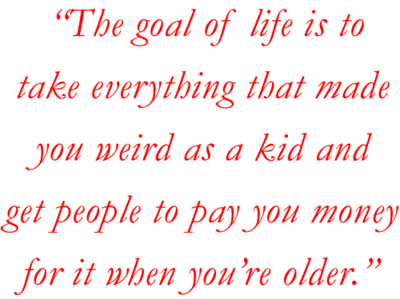
I’m feeling goodly today.  I read something in an old Radio Ink that Roy wrote about writers.  He quotes screenwriter David Freeman:

Lifegoal

My son, Will, turns six months old today.  Pay heed, boy.

Read the full article →

A Fine Tribute …

April 19, 2005

Central Missourians may know Tony Messenger through his words and stories.  I’ve never met the guy nor his subject … but I feel like I know them both. 

And, after reading his column in today’s Tribune, I feel like I know them both a little better.

And I’m a little better for choosing to read it:

Shakespeare’s Parking Lot Guy leaves behind lesson on choices


Published Tuesday, April 19, 2005


Sifting through her father’s old belongings in his cramped one-bedroom
apartment, Katherine Guffey is focused on a box of old photos that just
arrived via overnight delivery.


Her father, William Findlay Guffey, died Saturday night at his home above Boone Tavern.


Guffey had traveled to Columbia from her Sedona, Ariz., home a few days
earlier, having heard from friends of her 65-year-old father that his
time on Earth was nearing its end. Her dad was simply known as Fin, but
truly he was much more complex than the name implied.


It’s why she had her husband send a package of her old family photos of
Fin. She wanted to show them at his memorial service so her father’s
Columbia friends could see the man she grew up loving.


There he is as a young man dressed in a goofy winter hat and wearing snowshoes inside the family’s home in Maine.


There he is posing in his football uniform during high school.


There he is smiling at his wedding surrounded by family dressed to the nines.


Most telling, perhaps, is a yellowing newspaper article about the
overachieving high school senior getting another scholarship offer,
this time to Cornell University. "Young Guffey," the article points
out, was the president of student council and editor of the yearbook.
He played football and sang in the a cappella choir. He was an Eagle
Scout and was in the Latin Club.


"I think he got tired of all that stuff," Katherine says. "Along with
it came demands and high expectations. He was exceptional, and that
created a lot of pressure."


No doubt, folks in Columbia thought Fin was exceptional, too, but in a different understanding of the word’s meaning.


Exceptional in Guffey’s youth meant Ivy League schools, Fulbright
scholarships, advanced degrees and teaching appointments at the finest
schools back East. Guffey lived that life. He also lived the kind of
life that made him known as just a local guy with a heart who cared
about nothing but the people around him. That life was exceptional,
also, say the people he left behind.


"My dad sort of lived his life in phases," Katherine says.


The last several years have been the parking lot years.


Fin was the guy with the funny hats who directed cars in the parking
lot at Shakespeare’s Pizza. For $6.50 an hour, he stood or sat outside
and made sure the lot was used only by patrons. He came by his latest
endeavor just by being in the right place at the right time.


Fin was known as a guy who liked to enjoy a pint of beer now and then.
He enjoyed enough of them that the proprietors of The Old Heidelberg
gave him his own barstool, replete with a brass nameplate, on the
occasion of his birthday in 1989. It’s among the belongings his
daughter was packing up yesterday. About six years ago, remembers
Shakespeare’s General Manager Jen Brouk, Fin was sitting at the bar
when they decided the restaurant needed a parking lot attendant.


He worked his job all the way until about two weeks before he died. He
worked through the broken hip caused when he couldn’t get out of the
way of a car. He worked through the cancer that eventually killed him.
He worked in all kinds of weather, protected from the elements by his
top-quality L.L. Bean gear.


His winter clothing was, well, exceptional. That was his daughter’s
biggest surprise upon packing up his apartment. For a man who lived a
simple life just a few steps removed from the street, he had invested
in the finest winter clothing, most of it from clothiers such as L.L.
Bean and Land’s End. She pointed to the new boots on the floor. She
pulled out of a brand-new backpack a pair of expensive-looking arctic
mittens still in the package. These are Fin’s final gifts to the world.


Katherine believes he collected such quality winter clothing with the
intention of making sure folks in need got their hands on it after he
left the world. His daughter is committed to getting her father’s final
gifts directly to the hands of folks who need them most. "I’ll stand on
the street corner and hand them out if I have to," she says. "It’s what
he would want."


It’s one of the things she’ll remember her dad for: his gifts.


She remembers him declining to participate in a school library book
drive when she was a senior in high school. Instead, he bought her a
book. The book, "Death at an Early Age" by Jonathan Kozol, helped lead
her to a career in social work. Later, when she became a mother,
Katherine said, Fin would send her granddaughter books.


"All of the best books she has came from him," she says.


At 6 tonight at Shakespeare’s, Katherine will give a gift to her
father, sharing the rest of his life with the folks who knew him only
as the Parking Lot Guy. "I think his time at Shakespeare’s was the
happiest of his life," she says. "He loved the people there. He called
them ‘the kids.’ He liked being sort of a father figure to people. He
never really stopped being a teacher."


In the end, Fin was the man he wanted to be. That’s what Katherine says is his legacy.


"It’s one of the real lessons that my dad’s life could teach," she
says. "He did make choices that some people would say, ‘What a shame,
what a mistake.’ But if you listen to the people who knew him, his life
was not a mistake. He didn’t lecture people on their choices because he
didn’t want them to lecture him about his."


Fin Guffey chose to be a Parking Lot Guy. And he was so proud that he
actually monogrammed his fancy L.L. Bean shirts with the letters P.L.G.


Pretty lucky guy.


Tony Messenger is a columnist at the Tribune. His column
appears on Sunday and Tuesday through Thursday. He can be reached at
815-1728 or by e-mail at [email protected].

Thanks, Tony, for permission to reprint.
Read the full article →

Power of the Buzz

April 18, 2005

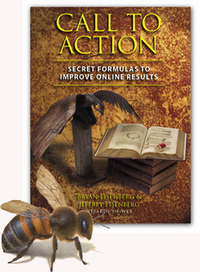
Bryan and Jeff Eisenberg have a New Book
The Monday Morning Memo by Roy H. Williams

Calltoactionmmmemo

People have said for decades, "Word-of-mouth is the best kind of
advertising. That’s the best kind: word-of-mouth." You hear this so
often when you sell advertising that my friend Bob Lepine used to joke
about opening The Word of Mouth Advertising Agency. He said he was
going to hire people to sit at bus stops and ride the elevators in tall
buildings and say to people, "Have you tried that new restaurant over
on Fifth Street? It’s GREAT!" The funniest part of Bob’s idea is that
it probably would’ve actually worked.

The power of the buzz – word-of-mouth advertising – lies in its
credibility. But the only way to create buzz is to rock a person’s
world so hard that they can’t help but talk about it to their friends.

I’m going to try to do that today.

Ray Bard of Bard Press, the publisher of my bestselling Wizard of
Ads trilogy, looked at the new hardback book about to be released by
Wizard Academy Press and wrote me an email. (I was walking out the door
to meet Ray for lunch when a boxful of advance copies arrived from the
printer. On impulse, I grabbed one for Ray.) These comments by email
were completely unsolicited:

Roy

Great to see you and catch up yesterday. And, thanks for the new
Wizard Academy Press book. I usually refrain from providing comments
about books after they’re published (I’ve made enough mistakes myself
over the years) but there is one issue that may deserve attention.

When I got home last night I gave the book a quick look. It felt
good in the hand and the inside contents looked good. Although the
title sounded like a political book and provided no information about
the content, I know that it can get by as it is. The other, more
difficult issue, is the price. When I first saw the $13.95 I thought it
was a mistake but noticed it was printed in two places. The last time
300 page hard cover business books sold for $13.95 was probably 30
years ago. The retail price is a statement of what you think the value
of the book is. When most similar business books are selling for twice
as much today, you can see the message this sends.

If the publisher is pursing a strong merchandising strategy with
lots of face out retail space I recommend pushing the retail into the
"value" category. Unless you have a new distribution effort, I would
not recommend it for this book. And, the $13.95 is way beyond "value"
pricing.

For what my opinion is worth, I would have priced it at $30. and
sold it at $20 for special customers. I think you can see the
difference in psychology.

Again, I regret bringing this up now, but I know the book will
be used in the company’s marketing efforts. And, as it is, the price
sends just the opposite message you want.

Ray

Ray Bard is America’s most successful publisher of business books. He
is responsible for putting two of my books on the Wall Street Journal
bestseller list and one on the New York Times list, so I listen
carefully to what Ray says.

He’s right. Thirteen ninety-five is way too cheap for a 326 page hardback containing this kind of detailed information about how to make online marketing actually work.
These pages are chock full of little-known techniques for improving
online marketing results. More than a dozen Fortune 500 companies have
paid the authors huge amounts of money to learn this stuff. That’s why
our plan all along was to price the second printing at 25.95. But this
first printing exists only to create a buzz. That’s why we’re giving you 2 additional copies for each one you buy at just $13.95.
We know you’ll give them to friends. We know your friends will be
rocked. We know your friends will talk about it to their friends. It’s
all about the buzz and this book contains some fabulous honey. By the
way, shipping is free if you live in the US, so you’ll have a grand
total of only 4.65 per book in each of your 3 hardback copies.

Wizard Academy Press is gambling that the information contained in
this book will give you a heady buzz and be worth mentioning to your
friends.

I’ll let you know in a few weeks how the experiment turns out. In the meantime, why not get 3 copies headed your way?
Roy H. Williams

PS – If the name Bob Lepine sounded
familiar, it’s because he’s been co-hosting a radio talk show for the
past 12 years heard in cities across America. Bob and I worked together
in Tulsa a quarter-century ago. I think often of all he taught me.

Read the full article →